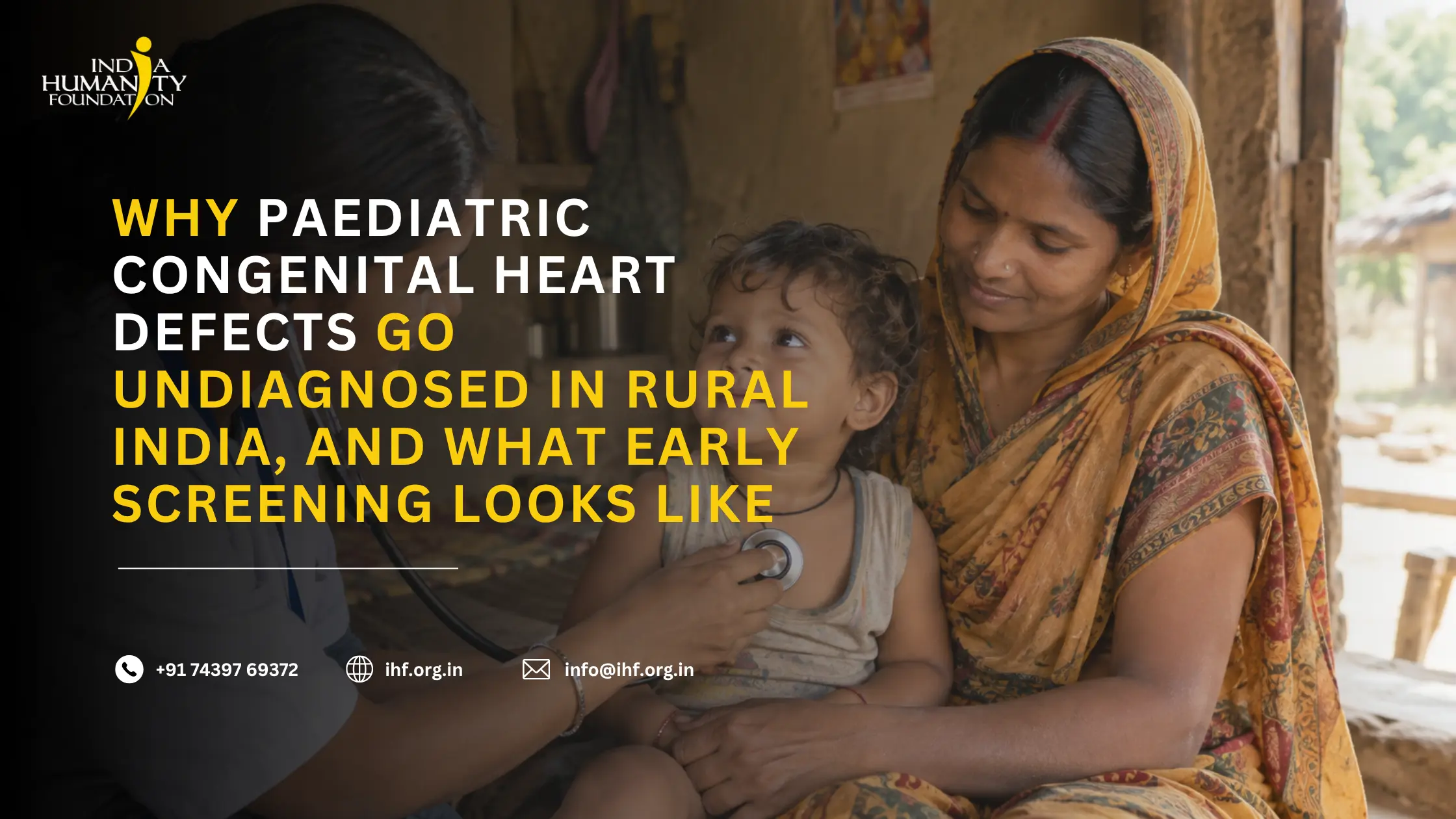
Why Paediatric Congenital Heart Defects Go Undiagnosed in Rural India, and What Early Screening Looks Like
A Heartbeat No One Heard
Ten-year-old Sunil (name changed to protect his privacy) lives in Bagda, a small village in North 24 Parganas, West Bengal. His family grows crops on a small farm. For years, Sunil struggled to run, play, and even breathe like other children. No one told his parents why.
He had a complex congenital heart defect. He has had it since birth. But nobody caught it in time.
Sunil's story is not rare. It is the story of thousands of children across rural India. Their hearts carry a defect from the day they are born. Their families do not know it. And by the time someone finds out, the child has already lost precious years.
This is the story we need to talk about.
The Scale of the Problem: What the Numbers Say
Let's start with the facts. Real numbers, from real research and government data.
Congenital heart disease (CHD) affects 8 to 10 out of every 1,000 live births in India, the estimate used by Indian Paediatrics, a peer-reviewed medical journal, based on national studies.
This means
over 2 lakh (200,000) Indian children are born with a heart defect every
single year.
Of these children,
about one in five has a serious defect that needs treatment within the
first year of life,
or the risk of death rises sharply.
India has only around 300 paediatric cardiologists for a population of over 1.4 billion, one specialist for every 4.5 million people. Compare this to the United States, which has one paediatric cardiologist for every 29,000 people.
India has roughly 50 tertiary paediatric cardiac centres capable of treating complex heart defects. Most sit in big cities in South and West India. Large states in the central, eastern, and northern belt (home to some of India's highest birth rates) often have none at all.
Now picture what these numbers mean for a family in a village like Bagda. The nearest specialist may be hundreds of kilometres away. The nearest hospital that can even diagnose the defect may not exist in the district at all.
This is not a story about bad luck. It is a story about distance, awareness, and access.
Why the Diagnosis Comes Too Late
A heart defect does not always show obvious signs. A baby may look normal at birth. The signs, fast breathing, blue lips, poor weight gain, tiredness during feeding, can be easy to miss, especially for a first-time parent or an overworked health worker with dozens of newborns to check each day.
In rural India, several barriers stack on top of each other.
1. Few specialists, fewer machines. Diagnosing CHD reliably needs an echocardiogram, a heart ultrasound read by a trained eye. Most Primary Health Centres (PHCs) and even many district hospitals do not have this equipment or a specialist to operate it. A large research review found that this shortage hits central, eastern, and northern India the hardest, regions with the country's highest birth rates.
2. Long distances, high costs. Even when a defect is suspected, families must often travel to a city for confirmation and treatment. For a farming or daily-wage family, this means lost income, travel costs, and days away from home on top of the medical bill itself.
3. Low awareness. Many families do not know that a heart defect is even possible, let alone treatable. A tired, breathless baby may be seen as "just weak" or "will grow out of it." Delay follows delay.
Gaps in follow-up. Even India's national screening programme, discussed below, faces real-world hurdles. A field study of the programme found that out-of-pocket costs and follow-up gaps still keep many diagnosed children from completing treatment.
Put together, these barriers mean one thing: a child's heart defect is often found only when it is already an emergency, or not found at all.
What Early Screening Looks Like: India's Answer
The good news is this: India already has a national programme built to catch
these defects early. It is called Rashtriya Bal Swasthya Karyakram (RBSK), run
by the Ministry of Health and Family Welfare under the National Health
Mission.
Here is how it works, in simple terms:
At birth: Doctors and nurses check every newborn at government health facilities for visible defects, including heart problems.
Weeks 1 to 6: ASHA workers, India's grassroots community health volunteers, visit homes to check on the baby and flag any warning signs.
Age 6 weeks to 6 years: Mobile Health Teams visit Anganwadi centres (village childcare centres) to screen children for what the programme calls the "4 Ds": Defects at birth, Diseases, Deficiencies, and Developmental delays.
Age 6 to 18 years: The same screening continues through government schools.
Referral: Any child suspected of having a heart defect is sent to a District Early Intervention Centre (DEIC), and if needed, on to a tertiary hospital for surgery, free of cost under the programme.
Since it began in 2013, RBSK has screened over 12 crore (120 million) children and found around 50.7 lakh (5 million) with a health condition needing care, including birth defects. Some states have gone further. Kerala's Hridyam programme, for instance, is often cited as a model for how early, organised screening can catch and treat CHD before it becomes a crisis.
RBSK proves one thing clearly: when screening reaches a village, defects that once went unseen start getting caught. The system exists. What it needs now is reach, resources, and support to go deeper into the areas that need it most.
What This Means for Every Family
If you are a parent in a village or small town, here is what matters:
A baby who breathes fast, tires quickly while feeding, or has bluish lips or nails should be seen by a doctor, even if they otherwise seem fine.
Ask your ASHA worker or Anganwadi centre if your child has been screened under RBSK.
A heart defect found early is often treatable, sometimes with a single surgery, giving a child a full, normal life.
Cost should never be the reason a child goes untreated. Government schemes and NGO-backed programmes exist precisely to remove that barrier.
Awareness is often the first and hardest step. Once a family knows what to look for and knows help exists, the rest becomes possible.
From Screening to Survival: The Saving Little Hearts Program
Government screening finds the child. What happens next, the surgery, the hospital stay, the cost of a new life, is where India Humanity Foundation (IHF) steps in.
Through The Saving Little Hearts Program, IHF ensures that a family's income never decides whether their child lives with a healthy heart. Working with leading cardiac hospitals, the programme has already supported more than 1,500 paediatric heart procedures for children who could not otherwise afford them.
This is not a distant statistic. It is Sunil, the ten-year-old from Bagda, whose family could never have paid for his two heart surgeries at R.N. Tagore Hospital, Kolkata, on their farming income alone. Through the Saving Little Hearts Program, Sunil received both procedures, fully funded. He has since returned home, breathing easily, playing like any other child his age.
IHF runs this work in partnership with the Yogita Kichlu Welfare Trust and the Rotary Club of Kolkata Benevolence. Together, they have brought life-saving cardiac care to disadvantaged children not just across India, but also to young patients from Ethiopia and Ghana, proof that a child's right to a healthy heart knows no border.
The programme's impact was recognised at the national level when Prime Minister Narendra Modi featured Saving Little Hearts in the 121st episode of Mann Ki Baat, aired on 27 April 2025, calling it a symbol of India's leadership in affordable, world-class healthcare.
Every rupee donated becomes a heartbeat restored, a childhood returned, a family freed from an impossible choice. Your support gives more children like Sunil the chance to simply breathe easy again.