Why India's Adult Literacy Rate Still Lags Behind
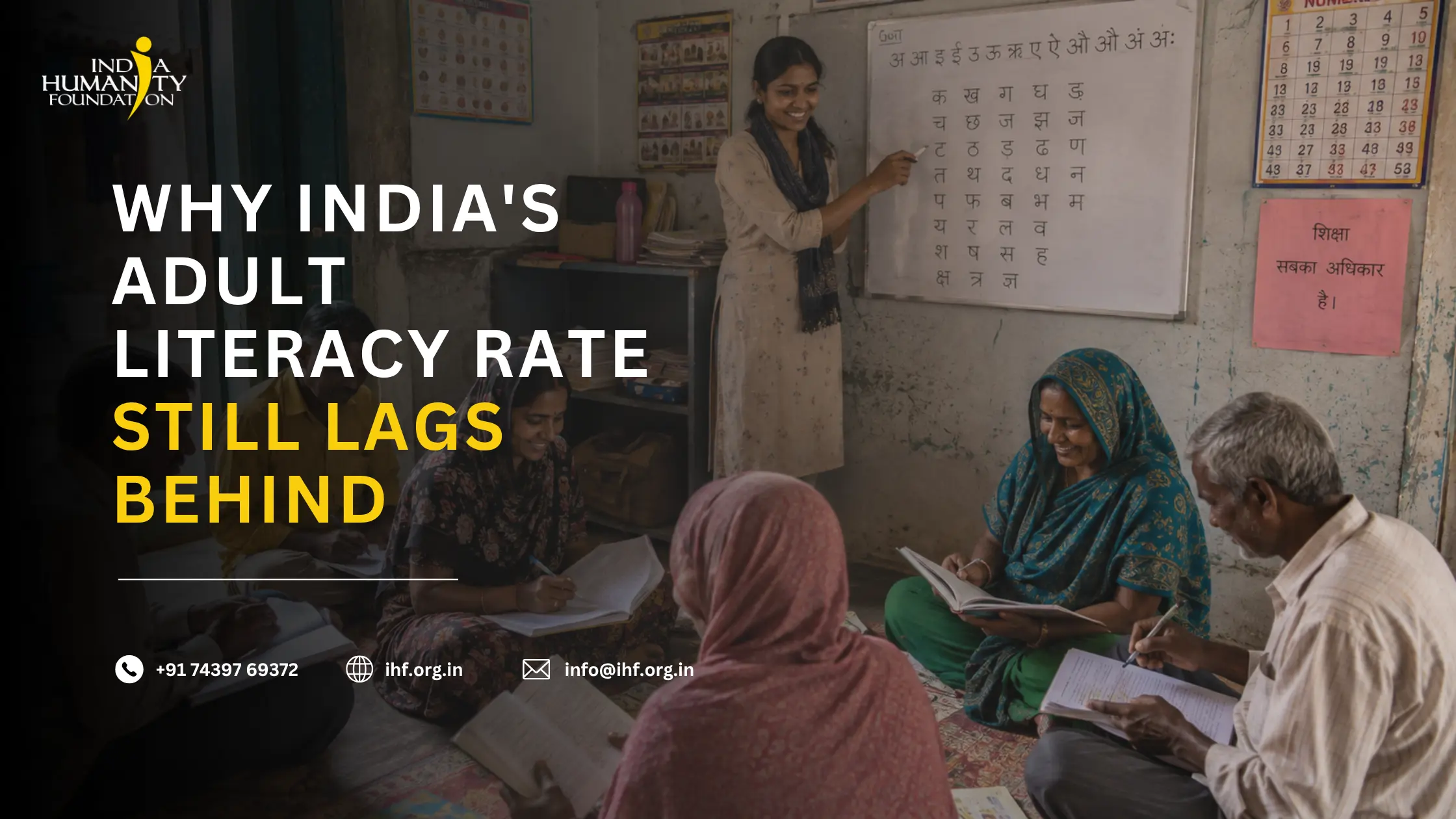
Joy Mandal is 69. Until recently, he could not read or write. Then Subham Mandal, a Class IX student at Bantra Madhu Sudan Paul Chowdhury High School in Howrah, stepped in as his guide under India Humanity Foundation's Diksha program, working through a standardized curriculum together until Joy could read on his own. His story reflects the reality facing nearly one in five Indian adults today, and it is a story India has not finished writing.
A Country That Reads, But Not All of It
India loves to celebrate its development, be it new IITs, unicorn startups, or a booming digital economy. But behind the headlines lies a quieter truth: only 80.9% of Indians aged seven and above can read and write, according to the Periodic Labour Force Survey (PLFS) 2023-24, conducted by the National Statistical Office (NSO). That gap is not spread evenly across ages. Literacy among children and teenagers in India is now close to universal, which means the shortfall of nearly 19% sits almost entirely with adults, people like Joy, who never got the chance to learn as children and have carried that gap ever since.
And the story changes depending on where you stand. Urban literacy stands at 88.9%, compared to 77.5% in rural India, a gap of more than 11 percentage points. The gender gap is wider still: male literacy is 87.2% against female literacy of 74.6%, a difference of 12.6 points. Literacy in India was never handed out equally. It followed roads, income, and gender, reaching some homes decades before it reached others.
The Silent Half of the Story
Here is the part of the story most people miss: an analysis of national literacy data by Data For India shows that nearly half of India's illiterate adults are over the age of 50. Sukta Das, 62, from Howrah, is one of them. She had never learned to read until Sumit Das, a Class VII student, began tutoring her through weekly, personalized sessions under IHF's Diksha model. She recently completed the program and became, as IHF puts it, "a literate citizen." These are not people who dropped out. Many never started. They were the sons sent to the fields instead of the classroom, the daughters married off before their tenth birthday, children of a country still learning how to build enough schools for everyone. Their illiteracy is not personal failure. It is historical debt, quietly passed down and rarely repaid.
And that debt compounds. A person who cannot read struggles to fill out a bank form, understand a medical prescription, or help a child with homework. Doors to higher education stay shut, not because of ability, but because the very first step, literacy, was never taken. The better-paying jobs that require that education, the kind that lift entire families out of poverty, remain out of reach for people who were never given a fair start. This is education inequality at its most human: not a lack of intelligence, but a lack of opportunity.
A Few States Are Proving It Can Change
Not every chapter of this story is bleak. On 20 May 2025, Mizoram became India's first fully literate state, crossing the 95% mark under the ULLAS - Nav Bharat Saaksharta Karyakram, a national literacy mission built on community volunteers and local classrooms. (Under ULLAS, "fully literate" means 95% literacy among adults aged 15 and above, a narrower population than the national figure above, which covers everyone aged seven and up.) Goa followed on 30 May, and Tripura on 23 June. These states prove something powerful: illiteracy is not permanent. It is a gap that closes the moment a community decides to close it. .
Where We Come In
At India Humanity Foundation, we see this up close, and Joy's story is one small part of a larger effort. Through our Diksha model, an each-one-teach-one approach, school students from Class VI onward each identify one non-literate adult in their community and teach them one-on-one, for a minimum of 45 to 60 minutes a day across 60 sessions, with progress checked after the 30th and 60th class. At the end, IHF conducts an examination equivalent to Grade III, and every learner who completes it receives a certificate of completion. Alongside Diksha, our Vidya model runs the same 60-session structure through community-based classes, led by trained local teachers known as Akshar Saathis. Together, these models are now active across 22 Indian states, running through more than 5,000 literacy centres and over 1.2 lakh student volunteers, and have made more than 300,000 adults literate so far.
India's literacy story is unfinished. But every adult who picks up a pencil for the first time, adults like Joy, is proof that it is still being written, and that this time, more hands are helping hold the pen.
You can be one of those hands. Donate, volunteer, or partner with us through CSR to help bring a classroom to a community that's still waiting for one.