What Is the Vidya Programme? Inside IHF's Approach to Adult Literacy
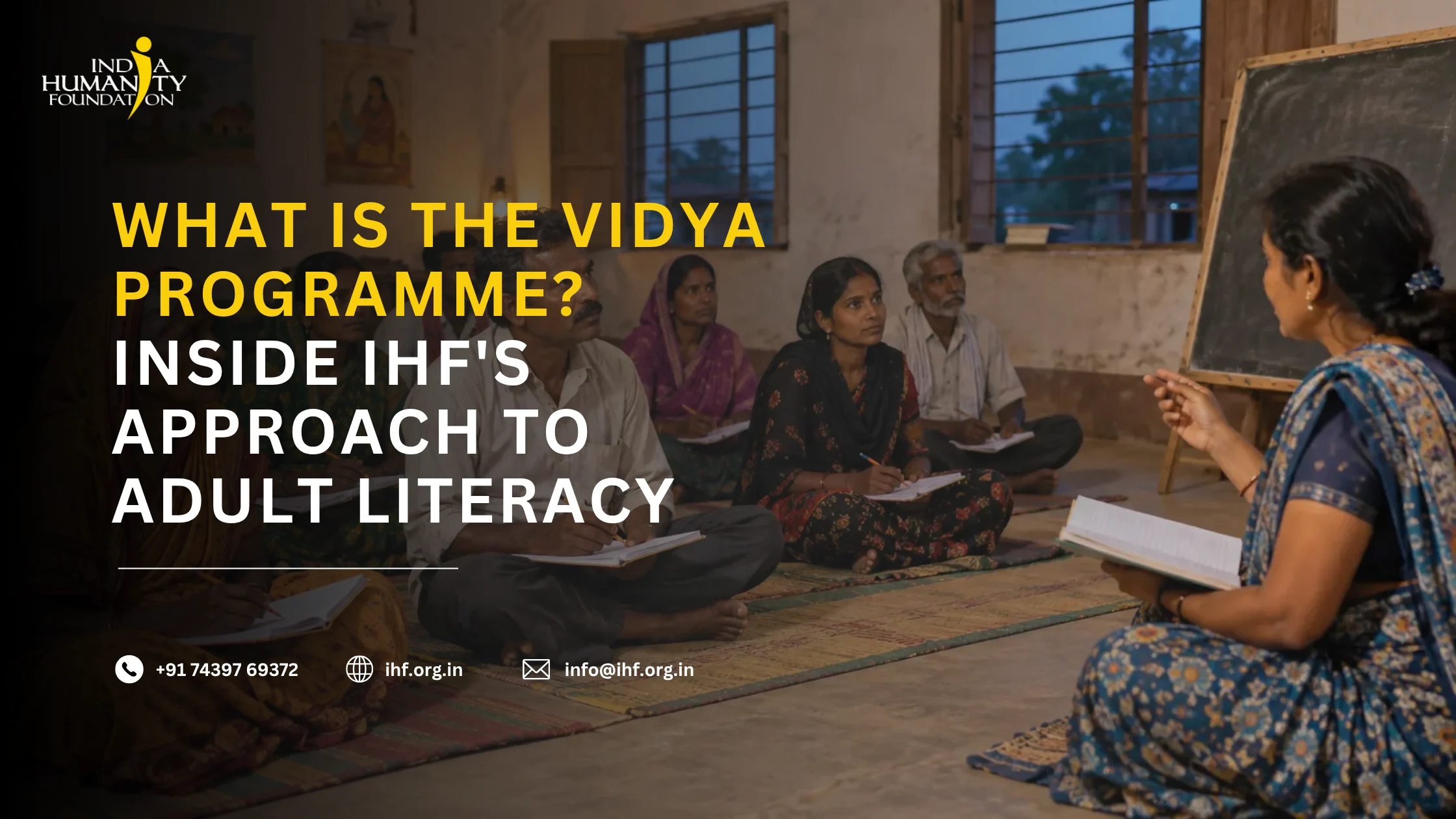
Every evening, in a community hall somewhere in rural India, a small group gathers on mats to learn to read, many of them for the first time. Grandmothers and daily wage workers who have just walked in from the fields sit facing one person from their own village who has agreed to teach them. India Humanity Foundation calls this the Vidya model. Here is how it actually works.
What Is the Vidya Model?
Vidya runs on a teach-many, not teach-one setup: instead of pairing one tutor with one learner, a single trained community teacher takes on an entire classroom.
That teacher is called an Akshar Sathi, or "letter companion." Usually someone from the same community, the Akshar Sathi brings together 30 to 40 non-literate adults at a shared space nearby: a panchayat hall, a school room after hours, or any room the community can spare. Over 60 sessions, roughly an hour each, the Akshar Sathi works through a structured set of books developed by IHF. Most learners reach functional literacy within three to six months.
The lessons go beyond the alphabet. Learners also pick up basic financial literacy and simple digital skills: enough to read a bus sign, fill out a form, or check a message on a phone without needing someone else to do it for them.
Who Can Become an Akshar Sathi?
The bar is set at a level people already in the community can meet: at least a standard X pass and access to a smartphone. Beyond that, IHF looks mainly for willingness, since the role means giving up evenings to teach people they already know.
From Registration to Certificate: How IHF Runs the Programme
Vidya isn't a one-off class. IHF runs it as a tracked programme, delivered with grassroots NGOs and local bodies, in four stages:
1. IHF identifies partner organizations and orients them, along with future Akshar Sathis, on how the model works.
2. Each Akshar Sathi identifies non-literate adults in their community, collects their details, and registers them on the IHF portal.
3. IHF's programme team runs formal assessments after the 30th and 60th class, checking progress in reading, writing, and basic math.
4. Learners who complete all 60 sessions and pass the assessment receive a certificate equivalent to Grade III: an official record that they're no longer counted among India's non-literate adults.
IHF defines a non-literate adult as someone aged 15 or above who cannot read aloud at 30 words a minute, cannot understand a road sign or newspaper, or cannot write and do simple sums.
The Numbers Behind the Model
Under its Adult Literacy programme, which includes Vidya, IHF has enrolled more than 4,00,000 adult learners so far, across 22 Indian states, through more than 5,000 literacy centres, with over 200 partner NGOs on the ground.
Get Involved
You can donate, volunteer, or partner through CSR to help bring a Vidya classroom to a community that doesn't have one yet.
As India moves toward the goals set out in NEP 2020, IHF remains committed to standing at the last mile, in the classrooms, courtyards, and community centres where the real work of literacy happens. Sixty years after the world first marked this day, our promise is simple: every person we reach should leave a little more capable of shaping their own future.