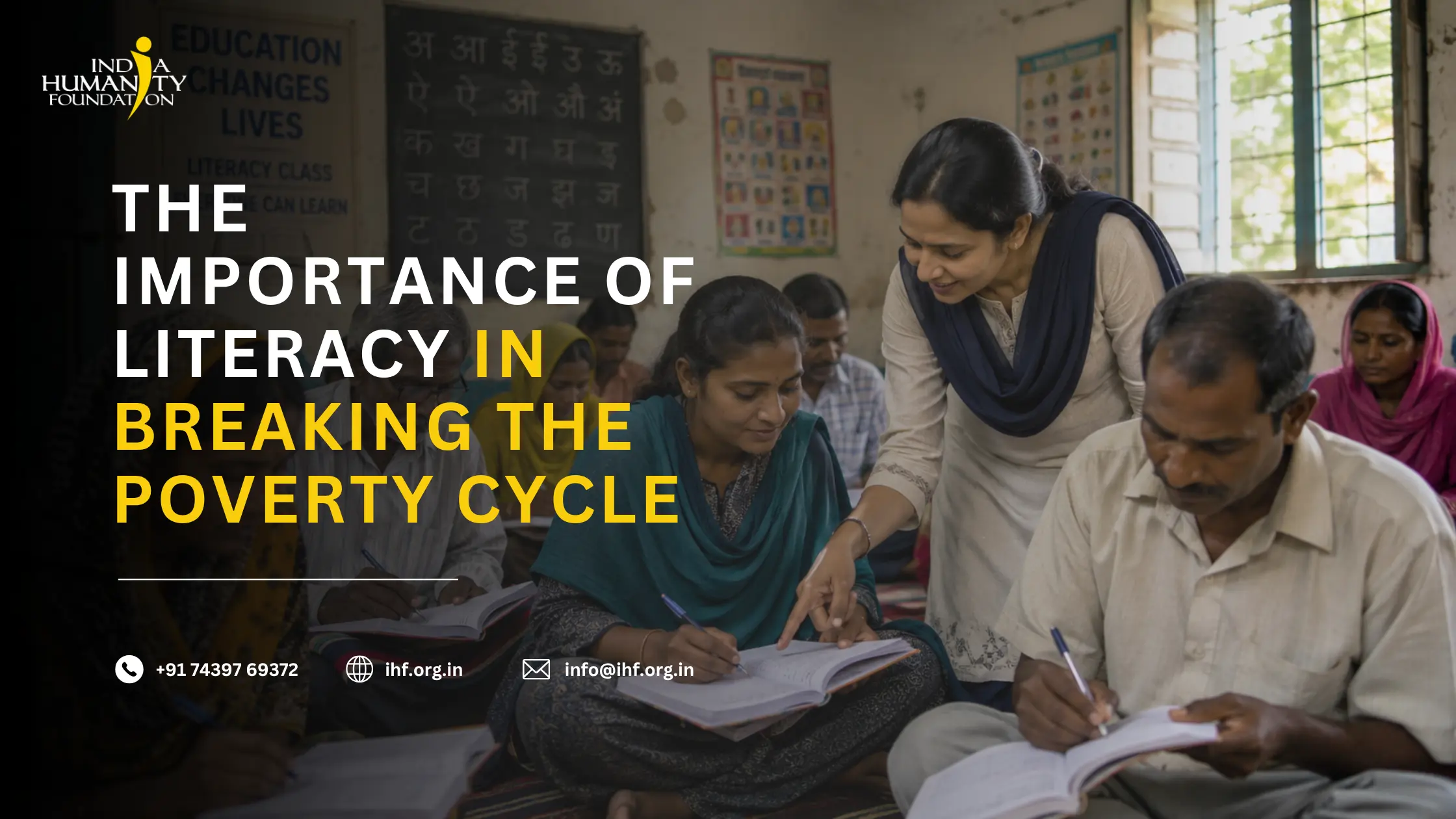
The Importance of Literacy in Breaking the Poverty Cycle
"Literacy is a bridge from misery to hope. It is a tool for daily life in
modern society. It is a bulwark against poverty..."
-Kofi Annan
The Weight of an Unread Word
India's literacy rate has risen from 74% at the time of the 2011 Census to 80.9% as of 2023-24, per the Periodic Labour Force Survey (PLFS), credited in large part to the government's ULLAS - Nav Bharat Saaksharta Karyakram. Yet behind that figure sits an older and heavier one: almost one in five Indians still cannot read or write, unable to make out a ration card, a medicine label, or a wage slip. The gap is sharper along familiar lines, rural literacy stands at 77.5% against 88.9% in urban India, and women trail men by more than twelve points, 74.6% to 87.2%. In reality, poverty and illiteracy coexist and mutually reinforce each other. If a parent cannot read, they cannot access the schemes meant for their own children. A worker who cannot read a contract has no way to know if he was paid what he was promised. Breaking one cycle means beginning to break the other.
A Nation Learning to Write Its Own Story
India is not standing still. Since 2022, ULLAS has enrolled over 2.8 crore learners and mobilised around 45 lakh volunteers, offering foundational literacy, life skills, and vocational training in 22 languages. Ladakh, Mizoram, Goa, Tripura, Himachal Pradesh, and now Sikkim have been declared fully literate. Alongside literacy, India's skilling mission through Skill India and the National Education Policy 2020 is teaching a generation that education does not end at primary schooling; it continues into a trade, a livelihood, a future, part of the wider fight against poverty that literacy alone cannot win.
Where IHF Walks In
This is the ground India Humanity Foundation has chosen to stand on. Through its Adult Literacy Program, active across 22 states, IHF has already helped more than 4,00,000 adults learn to read and write, using its Vidya and Diksha models, alongside teacher training and digital learning initiatives that reach further still. Registered under Sections 12A and 80G of the Income Tax Act and CSR-1 certified with the Ministry of Corporate Affairs, IHF turns compassion into accountable, measurable change, one of the concrete solutions to poverty that starts with a single learner.
Joy Mandal was 69 when a Class IX student from her neighbourhood began teaching her to read under IHF's Diksha model. Over sixty sessions, she learned what most children learn in a classroom: her letters, then her name, then whole sentences. She is one of more than 4,00,000 adults across India for whom that first classroom came decades late, and came anyway.
The Promise Ahead
A literate India is not a finished project. It is a promise renewed with every learner who picks up a pen for the first time. IHF's promise is to keep walking into the villages where that first word is still waiting to be written, until Making India Totally Literate is no longer a mission but a memory of what once needed doing. Join us: donate, volunteer, or explore a CSR partnership.