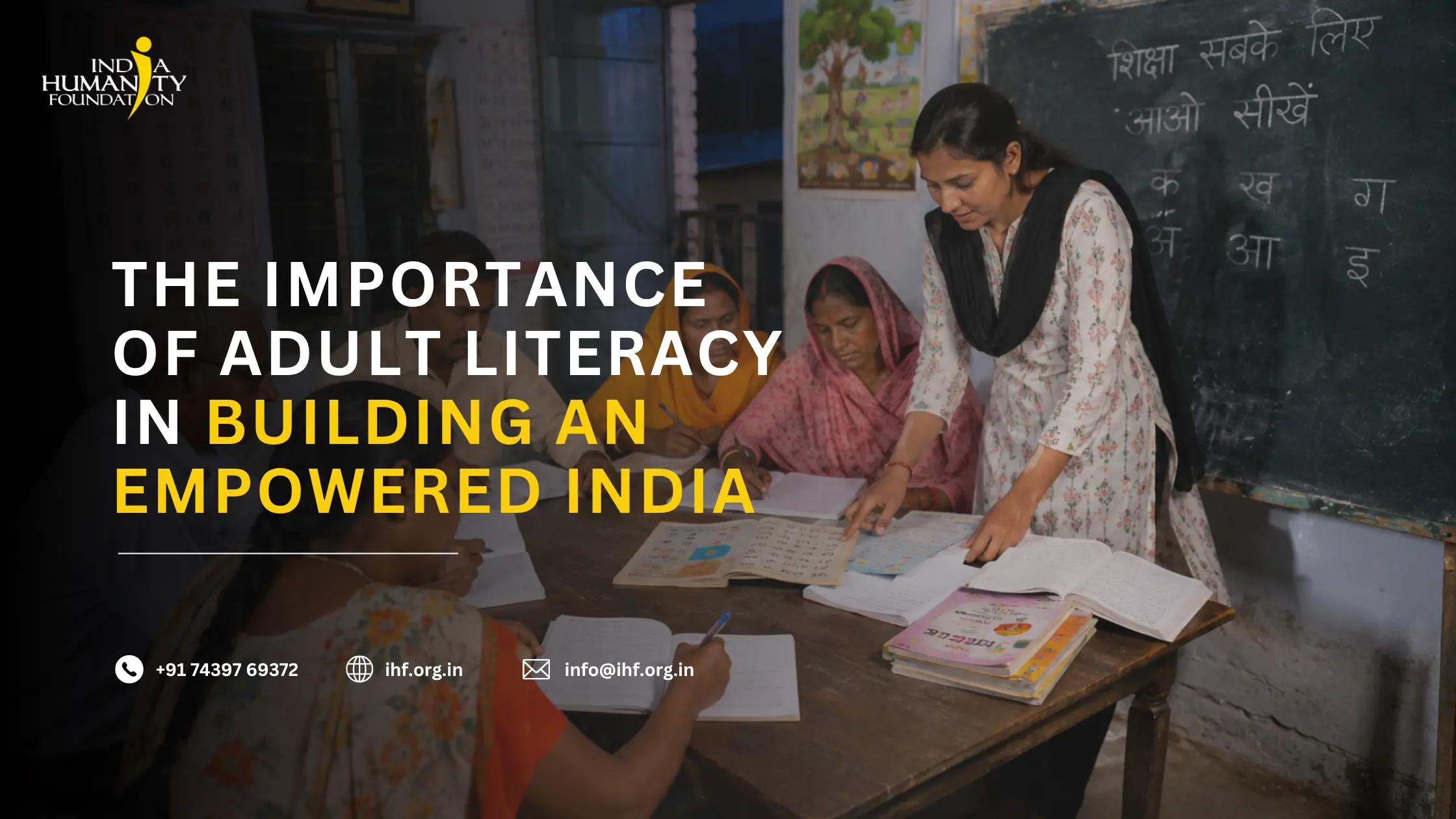
The Importance of Adult Literacy in Building an Empowered India
"It is never too late to learn something that changes everything that comes after."
Across India, a gap in reading and writing turns up in very different rooms — a correctional home, a village courtyard, a self-help group's ledger book. The setting changes, but the root is the same: a school year that never happened. One of these rooms is West Bengal's correctional homes, where the numbers are stark enough on their own.
Correctional Homes: Literacy as a Second Chance
At the Malda District Correctional Home in West Bengal, 83 inmates, including 12 who had themselves just been trained as teachers, sat down for an Adult Literacy Orientation Program, in the presence of Correctional Home Controller Shri Bhupendra Nath Biswas.
According to the National Crime Records Bureau's Prison Statistics India 2023 report, 25.1% of the country's prisoners were recorded as illiterate, and close to 40% had studied below Class X — nearly two-thirds of India's prison population without a completed school education.
India Humanity Foundation runs its Adult Literacy Program across all 61 correctional homes in West Bengal with Rotary Calcutta Mahanagar, using a peer-led model where 239 trained inmate teachers have taught 3,616 fellow inmates to read, write, and count.
Beyond Malda, the same program runs in every correctional home in the state — but the gap it addresses doesn't stop at the prison gate. It runs just as deep in the villages many inmates come from, and nowhere more sharply than among rural and tribal women.
Rural & Tribal Women: The Same Gap in Different Settings
According to the Periodic Labour Force Survey (PLFS) 2023–24, India's female literacy rate stands at 74.6% against 87.2% for men — a 12.6-point gap that falls hardest on rural and tribal women.
In rural West Bengal, where women often juggle farming and household chores, 23-year-old Sujata is one face of that gap closing. Despite her initial doubts about learning to read and write at her age, she joined an IHF literacy program in her village in Canning Block, South 24 Parganas. "The methods were transformative," Sujata says. "I can now write some words and read bus destinations, which has given me greater independence and mobility."
What Sujata gained wasn't literacy in the abstract — it was the ability to read a signboard, check a name, know what a slip of paper actually says. It's the same kind of tool: the ability to verify her own payment slip, or check her self-help group's savings entries herself, instead of waiting on a literate neighbour to read them out.
The same pattern extends to tribal communities, where literacy gaps compound with geographic isolation. IHF has taken up a dedicated Adult Literacy Program for 1,150 tribal women in Purulia district. Women here spend their days in agriculture and forest produce collection — work that has left little time for school, and little institutional support to make up for it.
One Program, Many Doors
Across these settings — correctional homes, tribal villages, and rural women's circles — IHF runs the same core model: its Vidya and Diksha adult literacy programs, which have together made over 4,00,000 adults literate across 22 Indian states. The setting changes; the method doesn't: meet learners exactly where they are — on a mat, in a courtyard, or inside a correctional home.
For Sujata in her village, for the women learning alongside her in Purulia's forests and fields, for an inmate in Malda preparing to return home, literacy arrives at different ages and in different rooms.
None of it happens without someone choosing to teach, and someone choosing to fund the space for that teaching to happen. If you'd like to be one of those people — as a donor, a volunteer, or a CSR partner — support IHF's Adult Literacy Program .
IHF is registered under Sections 12A and 80G of the Income Tax Act and is CSR-1 certified under the Ministry of Corporate Affairs.