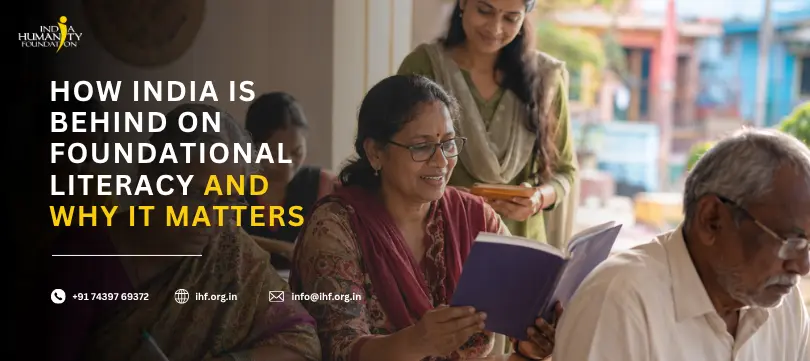
How India Is Behind on Foundational Literacy and Why It Matters
Sujata is 23. She grew up in a village in Canning Block, South 24 Parganas, splitting her days between farming and household chores. Nobody taught her to read at the right age, and by the time she was grown, that gap had followed her into every part of adult life — she couldn't read a bus destination board, let alone fill out a form. When she joined a literacy program run by India Humanity Foundation (IHF), she had her doubts about starting this late. "The methods were transformative," she says now. "I can now write some words and read bus destinations, which has given me greater independence and mobility."
Sujata's story is what happens when foundational literacy is missed the first time and never recovered. Today, that same gap is opening for a new generation, in classrooms, not decades later.
The Number That Should Worry Everyone
The Annual Status of Education Report of 2024 found that the share of Standard III children able to read at least a Standard II-level text stood at 20.9% in 2018, fell to 16.3% in 2022, and has now climbed to 23.4% in 2024, with government schools recovering faster than private ones. After most states saw reading levels decline in 2022, every single state showed improvement by 2024, and seven states — Himachal Pradesh, Uttarakhand, Kerala, Uttar Pradesh, Haryana, Odisha, and Maharashtra — posted gains of more than 10 percentage points in just two years.
It is real, hard-won progress. But it also means that even after this best-ever recovery, more than three out of every four Standard III children in government schools still cannot read a Standard II-level text. A good year of gains is not the same as a solved crisis.
India is still asking most of its youngest learners to build every future subject — mathematics, science, and civics — on a foundation that was never properly laid.
What the Policy Response Looks Like
India's National Education Policy (NEP) 2020 was the first to name this the country's top education priority, framing it as Foundational Literacy and Numeracy (FLN) under the "Foundational Stage" of schooling. Behind the framing came real money: in 2021-22 alone, ₹2,688.18 crore was approved under the Samagra Shiksha scheme for foundational-stage interventions across states, funding teacher training, learning assessments, and classroom materials. States are also experimenting with Teaching at the Right Level, grouping children by what they can actually do, not by age or grade, so a struggling nine-year-old isn't simply handed a book they cannot read.
How IHF Is Closing the Gap
India Humanity Foundation works across the same gap this piece describes, from the school building to the child sitting in front of the teacher. Its E-learning program installs curriculum-mapped audio-visual content, in local languages, directly into government and government-aided classrooms, reaching 27,368 schools so far through partnerships with Rotary Clubs, CSR contributors, and PSUs.
Alongside this, the Happy School program works on the physical space itself, upgrading the basic infrastructure a classroom needs to function at all, on the premise that a secure, welcoming school keeps children enrolled, attending, and paying attention long enough to actually learn.
Further upstream, the Padho Bharat campaign is building community libraries and putting books directly into children's hands, and the Diksha model, run by student volunteers, is repairing this same gap for adults it already failed, people like Sujata, now able to read and write for the first time in her twenties.
Joy Mandal was 69 when a Class IX student from her neighbourhood began teaching her to read under IHF's Diksha model. Over sixty sessions, she learned what most children learn in a classroom: her letters, then her name, then whole sentences. She is one of more than 4,00,000 adults across India for whom that first classroom came decades late, and came anyway.