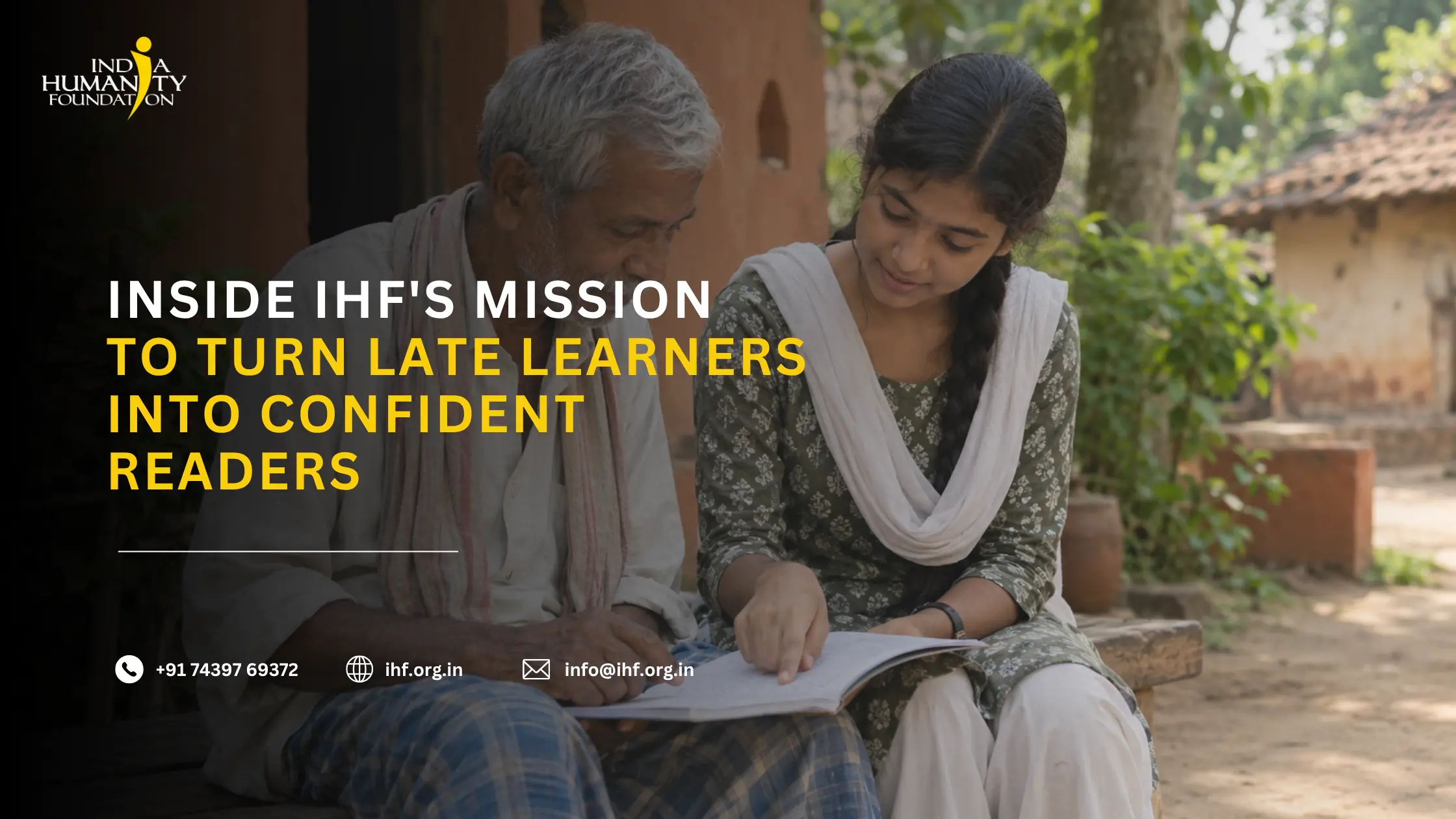
Adult Literacy Program in India: Inside IHF's Mission to Turn Late Learners Into Confident Readers
There's an old saying that it is never too late to be what you might have been. For lakhs of adults across India who missed the chance to hold a pencil in a classroom, that saying isn't a comfort. It's a plan of action, one that the India Humanity Foundation (IHF) has spent years turning into reality.
The Scale of the Challenge
Illiteracy among adults in India isn't a fringe issue. It touches people who spent decades working fields, running homes, and raising children without ever learning to read a bus sign or sign their own name. IHF has responded at scale: through its DIKSHA program, the organization has reached over 4,00,000 adults across 22 states (as of March 2026), teaching foundational reading, writing, and numeracy skills through a volunteer-led model.
What makes DIKSHA distinct is who does the teaching. Instead of relying only on professional educators, the program mobilizes student volunteers, often teenagers still in school themselves, to teach adults in their own communities. It's a model built on proximity: the teacher already knows the learner's language, routine, and neighborhood, which makes the classroom feel less like an institution and more like a conversation between neighbors.
Where Government Policy Meets Grassroots Action
IHF's work doesn't happen in isolation. It runs alongside a larger national push. The Government of India's ULLAS, or Nav Bharat Saksharta Karyakram, was launched following the recommendations of the National Education Policy 2020 as a five-year centrally sponsored scheme running from 2022 to 2027, aimed at empowering adults aged 15 and above who never had the opportunity to complete their education. The scheme's five components, foundational literacy and numeracy, critical life skills, basic education, vocational skills, and continuing education, mirror much of what grassroots organizations like IHF have been doing on the ground for years.
Under ULLAS, more than 2.80 crore learners have registered on the official mobile app, and more than 1.82 crore have appeared for exams across 33 states and union territories, with around 90 percent passing. States like Tripura have already been declared fully literate, becoming the third state after Mizoram and Goa to cross the 95 percent literacy benchmark, with Tripura's rate climbing from just 20.24 percent in 1961 to 95.6 percent today. These milestones show what's possible when policy and community-level programs like DIKSHA work in the same direction.
A Learner Who Chose to Start Again
Joy Mandal is 69 years old. He lives in Howrah, and for most of his life, reading was something other people did. That changed when Subham Mandal, a student in Class IX, began teaching him under IHF's DIKSHA program. There was no classroom, no textbook stacked syllabus, just a young volunteer sitting with an older man, letter by letter, until words started to make sense.
Joy's story isn't dramatic in the way a headline demands. He didn't go on to write a novel or pass a competitive exam. What he gained was smaller and, in its own way, larger: the ability to read a medicine label, understand a notice pinned outside a government office, and sign his name instead of pressing a thumb to an ink pad. For someone who spent nearly seven decades without that ability, it's not a small thing at all.
Why This Work Still Needs Support
Literacy programs like DIKSHA run on volunteers, donations, and partnerships, not on the momentum of a single successful year. Every new learner like Joy Mandal represents a volunteer who showed up, a donor who funded the material, or a CSR partner who backed the program's expansion into a new district.
IHF continues to grow this work across health, disaster management, water and environment, and girls' empowerment, but adult literacy remains one of its most direct interventions: a program that hands someone the tools to navigate the world on their own terms, often for the first time in their adult life.
If you'd like to support this work, whether through a donation, volunteering as a teacher, or partnering as a CSR sponsor, IHF's literacy program is built on exactly that kind of participation. Every volunteer who teaches someone like Joy Mandal to read is proof that the program works one person at a time.